


Introduction
Data centers and enterprises increasingly need 100G links across town or across regions. While coherent optics and DWDM systems are powerful, they’re sometimes overkill for a few long links. 100GBASE-ZR4 offers a simpler, standards-based option to reach up to 80km. This article expands on the practical benefits, trade-offs, and deployment advice.
What ZR4 actually delivers
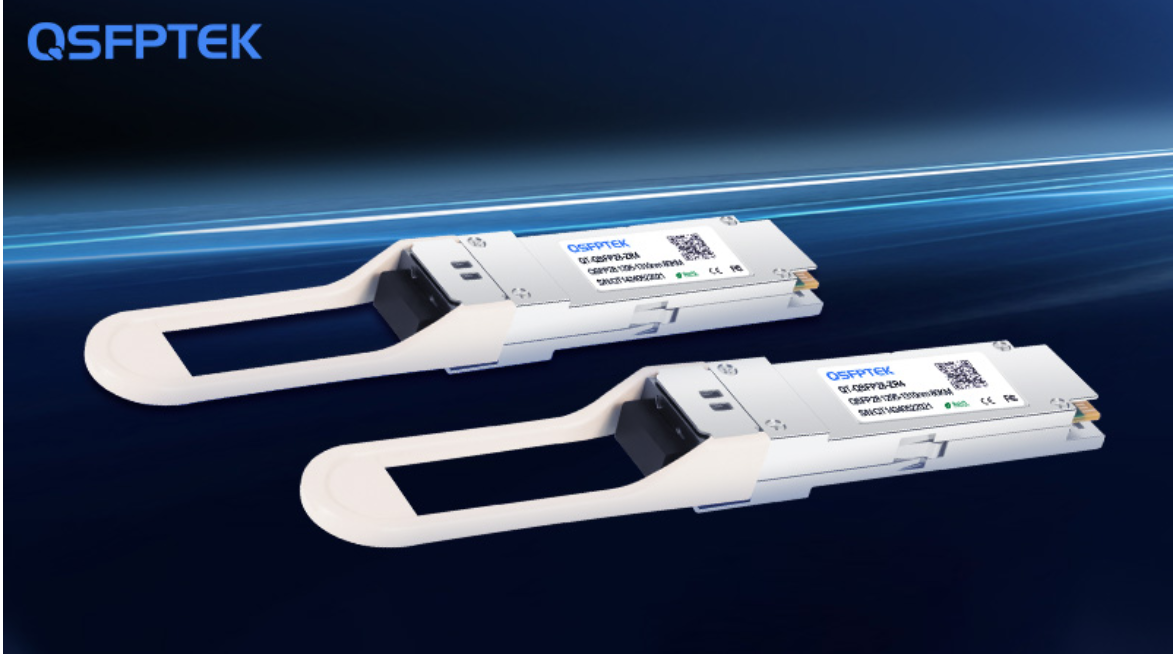
On a technical level, ZR4 packs four 25G channels into a QSFP28 module and sends them over single-mode fiber using CWDM in the 1310nm range. The optics are designed with higher launch power and more sensitive receivers than LR variants, which lets them tolerate the attenuation over tens of kilometers. That engineering difference is what turns a 10km LR link into an 80km ZR link.
Where ZR4 fits in real networks
ZR4 is often used for disaster recovery links between primary and secondary data centers inside a metro area, for business customer backhauls, or for connecting dispersed research facilities. It’s attractive when you want 100G bandwidth but don’t want the operational or capital burden of DWDM gear for just a handful of links.
Operational advantages: simplicity and speed of deployment
Because ZR4 uses QSFP28 ports, it fits into existing network equipment without special cards. That lowers integration complexity and makes deployment faster. You don’t need to provision DWDM wavelengths or manage transponders across multiple vendors. For teams that prioritize fast, low-risk deployment, ZR4 is an appealing choice.
Testing, monitoring, and operational hygiene
Long-span links leave less margin for error. Good practices include pre-deployment fiber testing—OTDR and insertion loss—and strict connector cleaning routines. ZR4’s DOM provides real-time telemetry that helps catch problems early: optical power levels, temperature, and voltage are all visible. That visibility, combined with rigorous testing, reduces surprise failures in production.
Cost comparison: ZR4 vs coherent/DWDM
If you only need a few long 100G links, 100GBASE-ZR4 usually has a lower total cost of ownership than setting up a DWDM system. But the economic story changes at scale: when you need many wavelengths across many sites, DWDM with coherent optics often becomes more economical. Think of ZR4 as the “right tool, right place” option: simple and cheap for small counts, less compelling at huge scale.
Physical and environmental considerations
ZR4 modules produce more heat and draw more power than shorter-reach 100G optics. In large numbers, that impacts cooling plans. Also consider fiber routing: long runs exposed to varying temperatures or poor-quality splicing can degrade the link. Designing with conservative optical budgets and planning for seasonal variations helps keep links stable.
Interop, procurement, and vendor strategy
Third-party ZR4 modules are now common, but don’t skip interoperability tests. Vendors use compatibility lists, but field validation is essential, especially on long runs. Procurement teams should balance cost savings from third-party optics with the operational peace-of-mind that comes from validated interoperable test results.
Final thoughts: ZR4 as a pragmatic long-haul choice
100GBASE-ZR4 gives many organizations access to long-haul 100G without over-complication. It isn’t a one-size-fits-all answer, but when used where it fits—carefully tested fiber, a limited number of links, and clear operational processes—it’s a powerful, cost-effective option. For teams that need dependable 100G at metro distances without the weight of DWDM, ZR4 remains a practical and sensible choice.
